

Expert-Led, Non-Surgical Care for Peyronie’s Disease
BOOK AN APPOINTMENT
Understanding Peyronie’s Disease
Peyronie’s disease is a condition in which scar tissue, called plaque, builds up inside the penis. The tissue forms in the tunica albuginea, the layer that surrounds the erectile tissue. As the plaque develops, it may affect the shape of the penis, causing it to bend or curve when erect. Some men may also notice pain, a dent or narrowing in the penis, or erectile dysfunction. Depending on the severity of the condition, this can make erections uncomfortable and sexual intercourse difficult or painful.
Common symptoms of Peyronie’s disease include
Symptoms can vary from person to person and may change over time. A clinical assessment can help determine the severity of the condition and the most suitable treatment.
Curvature or bending of the penis during an erection

Lump in the penis

Penile shortening

Indentation, narrowing or an hourglass-shaped appearance of the penis

Painful erections

Pain during sex activity

Difficulty with sexual intercourse

Erectile dysfunction in some men
Dr. Kamaraj’s Ultrasound-based Approach
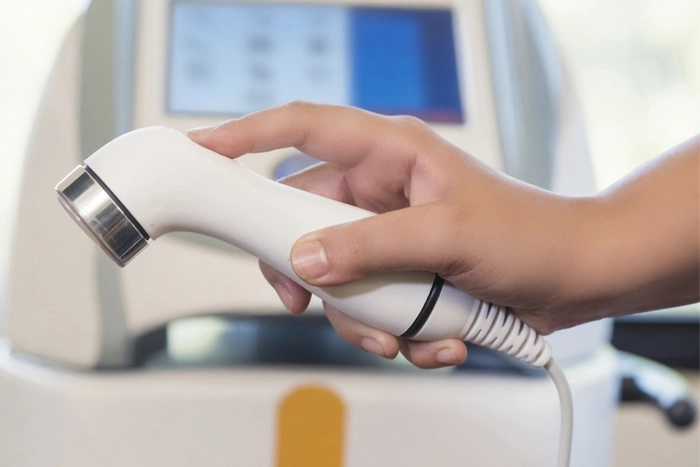
Peyronie’s disease, historically known as induratio penis plastica, was formally described by French surgeon François Gigot de la Peyronie in 1743, following earlier medical observations of penile curvature. Today, its assessment relies on a more structured diagnostic approach. Dr Kamaraj’s approach begins with a medical history and clinical examination, followed by diagnostic ultrasound to measure plaque size. Treatment targets areas of hardened tissue using advanced microcontroller-based, dual-frequency ultrasound equipment. Each session uses a 3 MHz frequency and lasts approximately 15 minutes, with around 20 sessions over two months. A follow-up ultrasound scan is then performed to compare plaque volume against the initial measurements and assess treatment progress.
Key features of this approach
Short sessions
Each session lasts about 15 minutes.

Non-Surgical
Does not involve an operation or surgical correction.

Ultrasound assessment
Measures plaque size before and after treatment and assesses changes in quality of life.

Cost-effective
As a non-invasive treatment, it may help reduce costs associated with surgery and hospital stays.
Book a consultation to discuss your symptoms and explore appropriate treatment options for Peyronie’s disease.
Why Consider A Non-surgical Approach?
Peyronie’s disease affects every individual differently, so treatment depends on the stage of the condition, degree of curvature, pain experienced by the patient, erectile function and its effect on sexual activity. Depending on these factors, treatment options may include medication, traction therapy, intralesional injections or surgery.
Treatment Outcomes
Consult the specialists at Dr Kamaraj Hospital for Men’s Health about ultrasound-based treatment for Peyronie’s disease today.
About Dr. T Kamaraj
Dr T. Kamaraj is a renowned infertility specialist and a leading expert in male reproductive health, with over 35 years of experience in the field. A visionary in men’s reproductive health and wellness in India, Dr Kamaraj has played a significant role in transforming the landscape of this speciality. He is the founder of Dr Kamaraj Hospital for Men’s Health and Wellness and Aakash Fertility Centre and Hospital. Additionally, he serves as the Chairman of the Indian Association for Sexology and the Director of the Indian Institute of Sexual Medicine, an institution affiliated with the World Association for Sexology.
Our Latest Videos
BOOK AN APPOINTMENT
FAQ
What are the possible causes of Peyronie’s disease?
What symptoms are associated with Peyronie’s disease?
What’s the process for diagnosing Peyronie’s disease?
Can Peyronie’s disease improve or resolve without treatment?
When should you seek medical advice for Peyronie’s disease?
57A, Jawaharlal Nehru Road, 100 Ft Road, Vadapalani, Chennai – 600026.
Mon-Sat: 8:00 am - 9:00 pm
Sun: 8:00 am - 5:00 pm